
| Previous: tip 1 | Next: tip 3 |
[EDR evasion tip 2/100] - Cure the Import Address Table with Dynamic API Resolution
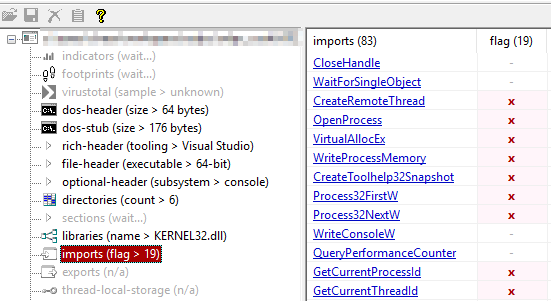
Before a Windows program runs, the loader needs to know which functions it plans to call from system DLLs (ntdll.dll, kernel32.dll, user32.dll, and others).
That declared list lives in the PE as the Import Address Table (IAT) - think of it as a shopping list of APIs baked into the file on disk.
Why EDR cares about the IAT 🔍
Static scanners do not need to execute your binary to know the APIs used. They parse the PE, walk the import directories, and the IAT and ask:
- Which DLLs are named?
- Which functions are named?
- Does this combination look like a malware, ransomware stub, or shellcode loader?
No behavior yet. Just labels on the box. If the shopping list screams “injection + decryption + remote thread,” you already look interesting for EDRs.
Commonly abused Windows APIs that may flag your binary if they show up in the IAT 📋
None of these are evil alone. Clean software uses them too. The tell is often clusters of sensitive APIs in a small, unusual binary:
VirtualAlloc/VirtualAllocEx/VirtualProtect/VirtualProtectExWriteProcessMemoryCreateRemoteThread/NtCreateThreadExOpenProcess/OpenThreadCreateProcessA/CreateProcessW
The first move: resolve APIs at runtime 🏃
If the sensitive names are sitting in the IAT, static detection is easy.
So operators often resolve APIs dynamically while the program runs: obtain a module handle and a function address only when needed, instead of declaring every sensitive call up front in the import table.
That breaks the direct association between the on-disk binary and those function names. The shopping list gets shorter. The file looks quieter to a lazy static pass.
Catch: you trade one IOC for another ⚠️
Dynamic resolution usually still needs a few helpers to bootstrap itself. Those helpers often land right back in the IAT:
LoadLibrary/LoadLibraryExGetModuleHandleGetProcAddress
So you hide VirtualAllocEx… and advertise “I look up functions by name at runtime” instead. Defenders know that pattern too. A tiny PE whose only interesting imports are the dynamic-resolution duo is still a smell.
Takeaway 💡
The IAT is a static confession of intent. EDR uses it because it is cheap, early, and does not require detonation.
Dynamic API resolution helps - but it is not free, yet!!
Tip 3 will dig into resolving those remaining bootstrap IOCs (LoadLibrary / GetModuleHandle / GetProcAddress) without leaving the same fingerprints.
Series: EDR evasion / Tip 2 of 100
| Previous: tip 1 | Next: tip 3 |